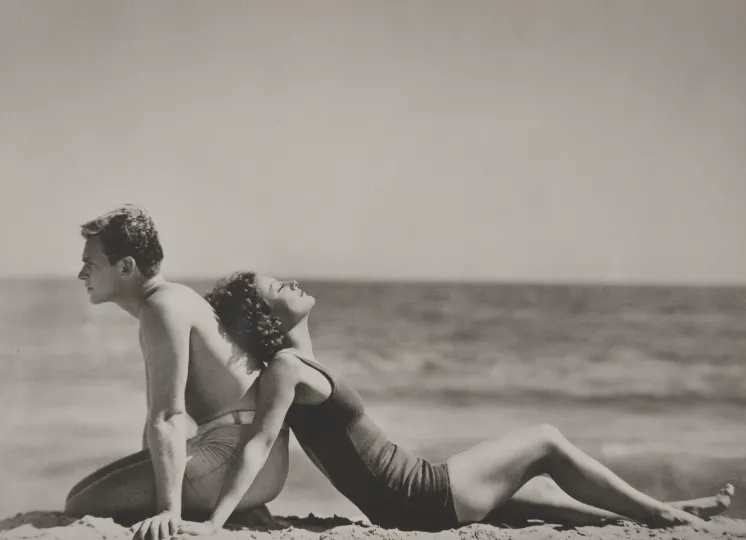
In conversation with our current photographic exhibition, American, born Hungary, this program focuses on two photographers whose multi-disciplinary work extended to motion pictures. Nickolas Muray and László Moholy-Nagy (born in the 1890s in Hungary and Austria-Hungary, respectively) both made an indelible impact on the world of photography. Utilizing the newer form of the moving image, they captured their unique vision and experience with a movie camera, to different audiences and effect. Moholy-Nagy worked independently as an avant-garde filmmaker in Germany and the United Kingdom, producing city symphonies, kinetic sculptures, and the play of light, as well as an early documentary on fishermen. Muray used his camera to capture home movies of his life and those of his friends, Eugene O’Neill, John Held, Frida Kahlo, Diego Rivera, and Miguel Covarrubias. These eight films, all preserved by the George Eastman Museum, reflect the personal and professional lives of these important photographers from the first decades of the twentieth century.
Piano accompaniment by Dr. Philip Carli.
Berliner Stilleben
(László Moholy-Nagy, Germany 1926, 10 min., 35mm)
Impressionen vom Alten Marseiller Hafen (Vieux Port)
(László Moholy-Nagy, Germany 1929, 11 min., 35mm)
Ein Lichtspiel
(László Moholy-Nagy, Germany 1930, 6 min., 16mm)
Gross Stadt Zigeuner
(László Moholy-Nagy, Germany 1932, 11 min., 35mm)
Lobsters
(László Moholy-Nagy, UK 1936, 16 min., 16mm)
[Home Movie - Muray - Eugene O’Neill and John Held in Bermuda]
(Nickolas Muray, Bermuda ca. 1924, 10 min., 16mm)
[Home Movie - Muray - shots of Kahlo, Rivera, and Covarrubias]
(Nickolas Muray, Mexico ca. 1941, 5 min., 16mm)
[Home Movie - Muray - Puebla, Mexico; Kahlo, Rivera, Covarrubias, and Arija]
(Nickolas Muray, Mexico ca. 1941, 8 min., 16mm)
Related